The difference between SUVs and 4x4 vehicles
By definition, a 4x4 is an off-road vehicle. Its four-wheel drive allows it to drive on difficult terrain that passenger cars would find difficult or impossible to drive on. 4x4s, for example, are driven in rallies. They are equipped with tyres which are specially designed for driving on rough and difficult terrain.
Most people refer to a group of vehicles as SUVs – and that often includes CUVs (also known as crossovers). SUVs and crossovers have similar ranges of high performance, storage capacity, superior handling on- and off-road, and fuel-efficiency.
In common language, there is a tendency to confuse the term 4x4 with SUV. However, it is important to distinguish between the two, as the tyres for each are different.
In this article we will focus on SUV tyres.
Are SUVs similar to 4x4 cars?
What is an SUV?
SUV stands for sport utility vehicle. SUVs entered the market as a way to provided drivers the comfort of a passenger car with the strength and power of a pickup truck. Mid to large SUVs are capable of hauling, towing, and serious off-roading. SUVs are built on the chassis and frame of a pickup truck (and often adopt the same body-on-frame), which means that they often sit higher and are heavier than other cars.
CUV, meanwhile, is short for “crossover utility vehicle”. CUVs – or crossovers – combine a sedan’s compactness with an SUV’s storage space and high performance. However, CUVs are often built on the chassis of a car.
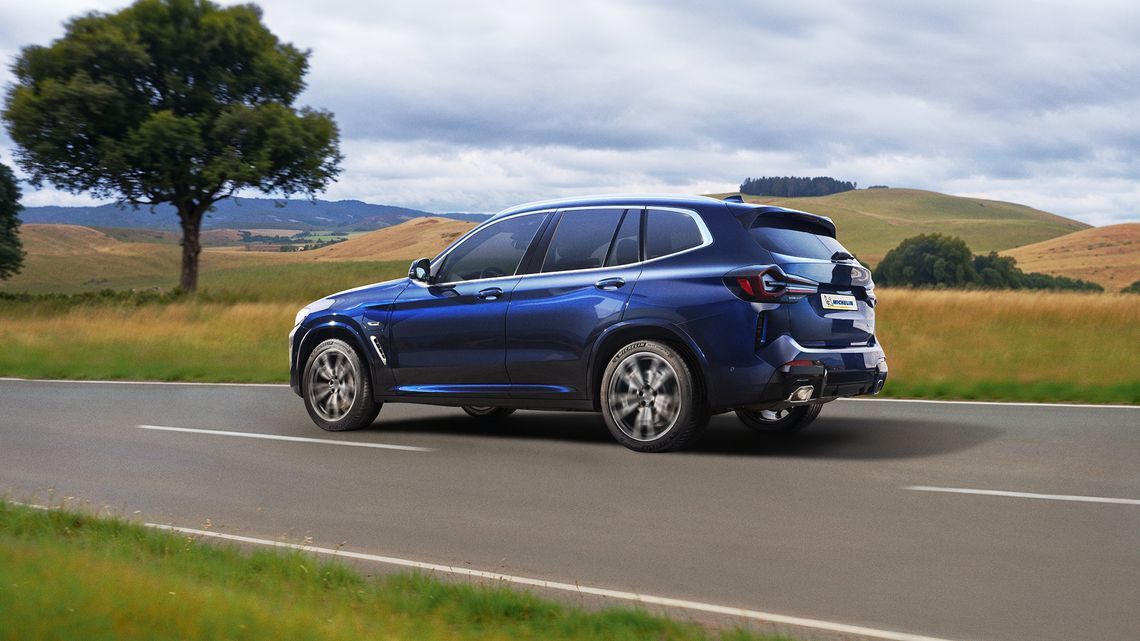
How to choose tyres for SUV cars with 4-wheel drive
For most SUVs that can take advantage of it, four-wheel drive is often offered as an option, and few consumers take it. In contrast, four-wheel drive is much more common on large SUVs and premium SUVs.
In other words, while SUVs may claim to have a rugged aesthetic, they are not necessarily equipped with an inter-deck differential lock or a short off-road gearbox. While they retain the ride height and rugged appearance of a 4x4, many have only two-wheel drive and have given up some of their off-road ability for better handling.
If your SUV has 4 wheel drive, you can follow the same selection criteria but MICHELIN strongly advises you to equip it with 4 identical tyres, i.e. of the same make and model, size and level of wear.
Do you have to change all 4 tyres on your 4-wheel drive SUV?
For optimum performance, we recommend changing all four tyres at the same time if your SUV is a four-wheel drive vehicle. Your vehicle owners manual will also provide guidance on this topic.
If your SUV has only two wheel drive, you do not need to change all four tyres at the same time. But it is recommended that you do it in pairs, i.e. the two tyres that are on the same axle.
What should I consider when looking for the best SUV tyres?
Traction. Will you be driving in unpredictable, uneven terrain, or mainly on highways? Better traction will help your car respond better while braking.
Handling. A shorter sidewall usually creates better handling and steering.
Clearance. If your 4-wheel SUV is suitable for larger tyres, this can increase the distance between the road surface and your vehicle, helping o prevent you from getting stuck in potholes and mud.
Aesthetics. While this isn’t the most important factor, you may want to consider how you want your vehicle to look.
Noise. High performance, luxury tyres can ensure a comfortable and quiet ride for you and your passengers.
We recommend you always choose tyres that match your manufacturer’s recommendations. Getting the proper tyres can ensure the best performance from your vehicle.

Find the right tyres for SUV 4-wheel driving today
Michelin tyres for SUV deliver long wear life, comfort, and traction, keeping you safe wherever you go. See some of best SUV tyres for your next journey below:
Or, if you want to learn more about the SUV tyres for sale or want to learn more about how to choose tyres for SUV 4-wheel driving, browse our full catalogue of Michelin tyres for SUVs. You can also use our tyre finder tool below to search by vehicle or tyre size.
See other related articles
-

How to choose the best tyres for my car
What tyres do I need? How to choose the best tyres for my car? If you are asking yourself these questions, our article will help you to consider the important criteria for making the right choice.
The tyre size might seem to be the only important factor in deciding which tyres to buy. However, as we will see, it is also essential to take into account your driving style and climatic conditions. To help you make the right choice, we'll also mention the European labelling system and provide you with a decision-making tool.View more -

How long do tyres last?
Wondering how long should tyres last?
Defining the lifespan of a tyre is difficult as there are many criteria involved, but by reading this article you will know how to preserve your tyres for as long as possible, when it is advisable to have them checked and which tyres guarantee the best performance until mile per kilometre.View more -

Everything You Need To Know About Checking Tyre Pressure
Maintaining the correct tyre pressure is one of the most critical yet overlooked aspects of vehicle maintenance. Knowing when, where, and how to check your tyres correctly is essential for maximizing fuel efficiency, extending tyre life, and ensuring your overall safety.View more